

en
SEO / GEO offers
SEO for whom?
SEO Where?
SEO for industries
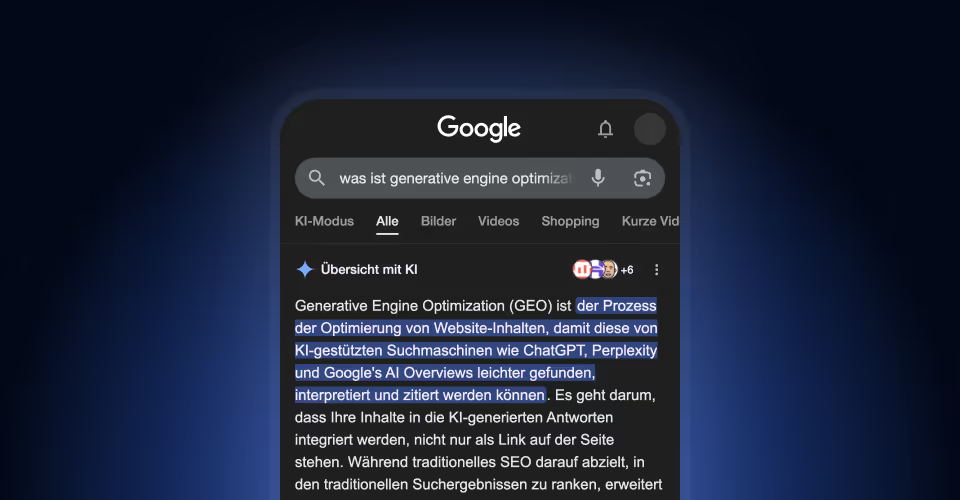
Generative search and AI assistants are changing the rules of the game in 2025: visibility is no longer just about classic Google rankings, but also about whether ChatGPT, Gemini, or Perplexity understand, cite, and recommend your content. This guide shows you exactly how to provide and structure your content faster – for better indexing and more mentions in AI responses.
Search is changing rapidly: answers are generated directly in the chat, users click through less often, and visibility is spreading across new channels. If you want your content to appear in these AI responses, you have to take action. It is no longer enough to just wait for search engines to crawl your website.
The goal: Not just letting machines crawl, but actively feeding them structured, up-to-date information. This approach is called GEO (Generative Engine Optimization) or LLMO (Large Language Model Optimization) – preparing content so that search engines and AI assistants can find it faster, understand it better, and cite it with confidence.
A specialized GEO & LLMO agency can support you with strategic implementation.
The challenge: If you just wait for Google or AI systems to crawl your website eventually, you are losing valuable time. For current topics, new products, or important updates, this can mean the difference between visibility and invisibility.
The solution: There are two ways you can provide your content faster and in a more structured way. Either you use a direct API integration, where you actively send information to the platforms. Or you work with optimized delivery methods, if no API is available – by preparing your content so that it is optimally discovered and processed.
Both approaches offer you decisive advantages: your changes are detected faster instead of waiting for the next crawl. Additional information helps AI models correctly understand your content. You retain control over which content is available and how, and you can identify issues early on. Automation saves a tremendous amount of time, especially for large websites.
Google Indexing API is currently only available for two specific content types:
Relevant for: Job boards, recruitment agencies, companies with many job postings, event organizers with live streams.
Practical implementation: Implement the API for automatic notifications for new or updated jobs and events. Ensure that changes are reported immediately and use the Search Console API for monitoring and error analysis.
For blog posts, product pages, services, and all other content, there is no direct API. Here, you work with proven optimization methods that are still highly effective.
Start by maintaining an up-to-date XML sitemap with the correct <lastmod> date and create separate sitemaps for news, videos, and images. Submit these to Google Search Console. Mark up your content with structured data (Schema.org) using appropriate types such as Product, Article, HowTo, or FAQ – precisely and verifiably. Use the Rich Results Test to identify errors.
On a technical level, correct canonical tags, the avoidance of duplicates and 404 errors, and optimized loading speeds are crucial. Also, ensure that all important content is visible without JavaScript.
Why this works: Google crawls websites with a clear structure and current sitemaps faster and more thoroughly. Technical SEO forms the foundation here.
OpenAI offers the Files API and Assistants API , which allow you to upload documents and use them as a knowledge base.
Relevant for: Companies with product documentation, manuals, FAQ collections, and knowledge bases.
How it works:
Practical implementation: Structure your content into clear, thematically organized files and keep them up to date with automated uploads whenever changes occur. Use clear metadata such as date, version, and topic, and explicitly request citations in your prompts. This keeps the origin of the information transparent.
What you can achieve: ChatGPT paraphrases your content accurately, provides sources, and stays up to date – however, there is no guarantee of being mentioned in public chats.
Google offers several integration options for Gemini:
Who this is relevant for: Companies already using Google Workspace and enterprise clients with sensitive data that should not be public.
How it works:
Practical implementation: Create a central knowledge base with unique IDs and enable grounding with trusted domains. Use fine granularity—paragraphs rather than entire documents—and log sources for future audits. This allows you to maintain control over the quality of the AI's responses.
Key feature: Grounding significantly reduces hallucinations because Gemini must base its statements on concrete sources.
Perplexity currently offers no API for publishers to submit content directly. Instead, Perplexity crawls the web and actively cites sources.
The Perplexity API, which does exist, is intended for developers who want to integrate Perplexity into their applications—not the other way around.
What you can do instead:
First, ensure optimal crawlability: Maintain up-to-date XML sitemaps, provide RSS/Atom feeds for new content, avoid blocks in robots.txt, and ensure fast loading times.
Then create citeable content with clear, unambiguous statements, concise subheadings, and structured sections. Tables, lists, and FAQ sections are just as helpful as concrete facts and figures.
For metadata , clear titles and descriptions, author tags, up-to-date lastmod entries, and canonical URLs are essential.
Why this works: Perplexity favors sources that are well-structured, current, and fact-dense. The easier you make it for the AI, the more likely your website is to be cited.
Grok by xAI uses web access and X content, but offers no API for publishers.
What you can do instead:
Optimize your website fundamentals: Ensure bots have access (check robots.txt), use structured data (Schema.org), avoid content that relies on JavaScript, and provide static HTML fallbacks.
Leverage social media synergyby sharing content on X (formerly Twitter) with clear summaries, linking to full articles on your website, and using Twitter/X Cards for better previews.
Ensure technical clarity through optimized Open Graph and Twitter Card tags, clear directives in robots.txt, and provided change logs and FAQs.
Special feature: Grok has access to real-time discussions via X. A strong presence on X can indirectly increase the visibility of your content.
Claude can process documents directly and be integrated into RAG (Retrieval-Augmented Generation) systems via the API.
Relevant for: Developers integrating Claude into their own applications, companies with extensive documentation.
How it works:
Practical implementation: Segment documents into chunks with stable IDs and maintain metadata such as date, author, and version. Use clear prompt templates for consistent responses and automate re-embeddings after changes to keep the knowledge base up to date.
What you should keep in mind: Claude is particularly strong with complex, long documents. The quality of the responses depends heavily on the structure of your source documents.
Actively providing content—whether via API or optimized alternatives—is particularly worthwhile for websites where timeliness and reliability are critical.
News publishers and blogs benefit from the rapid indexing of current content. Job boards and event websites can use the Google Indexing API directly, while e-commerce platforms with frequent price and inventory changes also see significant benefits.
For SaaS documentation with release notes and manuals, knowledge bases with FAQs and how-tos, as well as regulated industries with compliance notices and legal updates, structured delivery is often business-critical. Local businesses with dynamic opening hours and offers, as well as large-scale portals with thousands of URLs that need to be managed efficiently, should also rely on automation.
Especially in the context of SEO for large enterprises automation is crucial. An experienced SEO agency like ZUMO helps with professional integration.
APIs and optimized delivery increase your visibility—but only if the content is accurate and well-maintained.
Version your documents with clear timestamps, enforce source citations in AI responses, and test changes before they go live. Set up monitoring to track where and how your content is cited—and link mentions to conversions, not just rankings. Use tools like Google Search Console and Analytics for data-driven insights.
Conduct regular SEO audits with AI visibility metrics, check fact-checking rates and citation coverage, and update outdated information promptly. Also, keep in mind legal aspects such as data protection, rate limits, content rights, and compliance requirements.
For all websites the fundamentals are crucial: optimize your XML sitemaps and keep them up to date, implement structured data (Schema.org), and check technical basics like load time, mobile optimization, and crawlability. Prepare your content in a structured and citable format.
Use APIs where available: The Google Indexing API for jobs and events, the ChatGPT Files API for documentation, Gemini for enterprise knowledge bases, and Claude for developer-based integrations offer direct access.
Where no APIs are available, optimize content quality and structure for platforms like Perplexity and Grok. RSS feeds for news and updates, a strong social media presence for additional signals, and well-thought-out metadata and previews make all the difference.
Define clear metrics: time to indexing and visibility, frequency of citations in AI responses, traffic from generative searches, and conversions from AI-referenced visits.
First, analyze your current situation—what content types do you have, and where are APIs available? Then, prioritize quick wins like XML sitemaps and structured data, which can be implemented rapidly. Automate workflows, especially if you have a lot of content, and measure continuously: what works for you, and where are you getting the most mentions? Stay flexible, as AI models and features are evolving rapidly.
The combination of direct API integrations (where available) and optimized delivery methods (where not) is the most pragmatic path to greater visibility in generative search.
You don't have to start perfectly —begin with the basics and build step by step. Those who act now will secure a head start while others are still waiting.
Need support? A specialized SEO agency like ZUMO can help you with strategy, implementation, and performance measurement—from technical integration to content optimization.
Important to understand: There is no guarantee of being mentioned in AI responses. However, with the right methods, you significantly increase the probability. Generative search rewards quality, structure, and relevance—just like traditional SEO, only with new rules of the game.
If you want to know how to implement GEO in your organization, book a free strategy call with ZUMO now.
Our team of SEO experts is ready to help you. Discover your SEO potential in a free initial consultation!

ZUMO is a Swiss SEO & SEA agency that uses data analysis and market research to develop scientifically sound SEO & SEA strategies. We owe our success to a combination of technology and know-how of our employees, which delivers relevant results at a unique speed. The satisfaction of our customers, no matter if corporation or small business, is our ultimate goal.





.avif)

.avif)
.avif)
