en
SEO / GEO offers
SEO for whom?
SEO Where?
SEO for industries

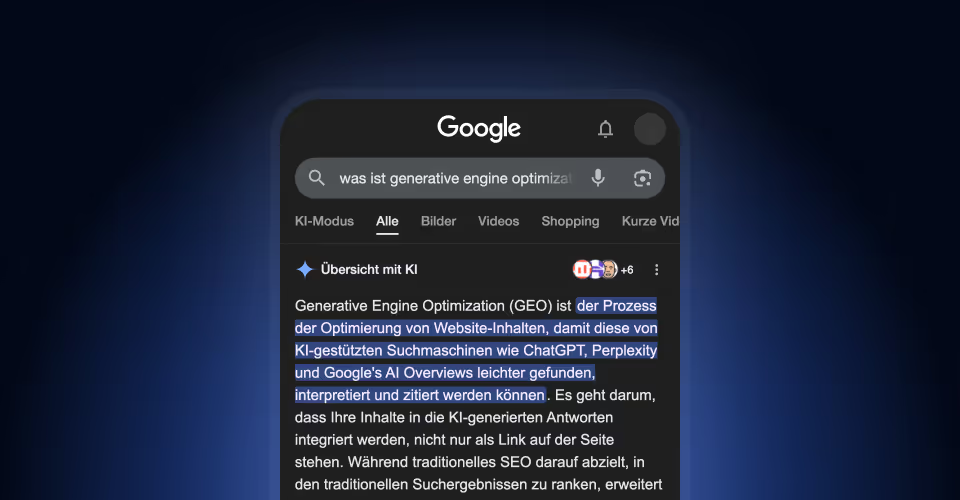
A date that has captured the attention of the SEO world: On May 15, 2026, Google published official documentation on optimizing for generative AI features in Google Search for the first time. Not a blog post, not a Twitter thread, but a comprehensive guide directly within the Google Search Central Documentation: "Optimizing your website for generative AI features on Google Search". A clear signal that the topics of GEO and AI visibility have officially arrived at Google.
In this article, we explain what Google says in this guide, what is truly important, and what you can safely ignore from now on.
Google officially confirms: SEO remains the foundation for AI visibility. Generative features like AI Overviews and AI Mode are based on the same ranking and quality systems as traditional Google Search. If you are doing good SEO, you are fundamentally well-positioned for AI search.
Google explicitly acknowledges the terms GEO and AEO, but classifies them as an extension of SEO rather than a separate discipline.
The guide debunks several myths: llms.txt files, artificial "content chunking," and writing specifically for AI systems offer no advantage. The focus remains on unique, helpful content for real people.
New and forward-looking is the chapter on "Agentic Experiences": AI agents that act independently on websites are becoming the next relevant channel.
Since the rise of ChatGPT, Perplexity, and Google AI Overviews, countless theories have circulated about how to optimize for AI systems. So-called "GEO hacks" and "AEO tricks" filled blog after blog, often without any foundation.
Google has now taken an official stance for the first time. The guide has been integrated directly into the Search Central documentation, alongside the SEO Starter Guide and technical fundamentals. This is a powerful signal.
For every SEO agency , this guide is mandatory reading and a welcome corrective to the noise in the market.
Google is clear: Existing SEO best practices remain valid. Generative AI features are based on Retrieval-Augmented Generation (RAG), which involves retrieving content from the existing search index. Content that is well-indexed and has strong quality signals will also be considered for AI Overviews and AI Mode.
Specifically, Google mentions two core techniques:
Retrieval-Augmented Generation (RAG): The system retrieves current, relevant webpages from the search index and generates an answer from them, including linked sources. Anyone in the index with high-quality content has a chance at visibility.
Query Fan-Out: The model generates several related queries in parallel for a single search request to provide better results. Websites with a broader thematic scope benefit from this.
GEO (Generative Engine Optimization) and AEO (Answer Engine Optimization) are explicitly recognized by Google as established terms and are classified as an extension of traditional SEO, not a replacement. As a GEO agency we see this as confirmation of our approach: SEO and GEO belong together.
Google’s strongest signal concerns content. The goal: unique, experience-based content that doesn't simply repeat what is already everywhere else.
Google calls it the difference between "commodity content" and "non-commodity content." An article like "7 tips for first-time buyers" is interchangeable. A personal account with real insights, data, and concrete perspectives is not.
Anyone writing content just for keywords or inflating existing content with AI tools will be just as invisible in AI search as they are in traditional search. Here, too, substance is what counts.
This section of the guide is particularly valuable because Google explicitly states what is not necessary:
llms.txt and similar files: No special markup files or AI text files are needed to appear in generative search. Google indexes many file types, but that does not grant them special treatment.
Content "chunking": Content does not need to be broken down into small chunks for AI systems to understand it better. Google can process complex, multi-page content as well.
Rewriting for AI: No special writing style is required for AI systems. Synonyms and topical relevance are recognized even without exact keyword matches.
Inauthentic mentions: Artificially generated mentions in blogs or forums do not help. Ranking systems recognize high-quality content, and spam systems recognize the opposite.
Structured data as a requirement: Schema markup is not a prerequisite for AI visibility. However, it remains useful for rich results and better interpretability.
The guide confirms many of the fundamental principles that we, as an experienced SEO agency , have been following for years. Here are the priorities for practical application:
Secure the technical foundation: Pages must be crawlable, indexable, and snippet-ready. This is the basic requirement for visibility in AI Overviews. Crawl budget, loading times, clean HTML, and a clear page structure are not optional measures.
Content quality over quantity: Unique, experience-based content beats generic volume. Genuine expertise, clear structuring with headings and paragraphs, as well as supplementary images and videos, are the right way to go.
Maintain local and e-commerce data: Google Merchant Center and Google Business Profile feed directly into AI responses. Those who are well-positioned here have a clear advantage.
Keep an eye on agentic experiences: AI agents that act independently on websites are the next step in development. Semantic HTML, accessible structures, and reachable DOM elements are the preparation for this. In this section, Google refers to protocols such as the Universal Commerce Protocol (UCP), an area that will gain significant importance in 2026 and beyond.
What Google confirms with this guide is what we, as a GEO agency , have advocated from the start: SEO / GEO is not an either-or. Generative visibility builds on classic SEO foundations and expands upon them.
Investing in SEO today means investing in GEO at the same time. If you want to achieve AI visibility, you need the technical and content foundation that good SEO provides. Trying to separate the two terms helps no one.
Google's first official AI optimization guide sends a clear message to the industry: no hype, no shortcuts, no tricks. Good SEO remains the foundation. Non-commodity content is what makes the difference. Those who master the technical basics are also well-positioned for AI search.
For companies wondering if their current SEO/GEO approach is future-proof, the answer is: yes, provided it is built on substance, structure, and genuine expertise. That is exactly what Google evaluates and what AI systems cite.
Our team of SEO experts is ready to help you. Discover your SEO potential in a free initial consultation!

ZUMO is a Swiss SEO & SEA agency that uses data analysis and market research to develop scientifically sound SEO & SEA strategies. We owe our success to a combination of technology and know-how of our employees, which delivers relevant results at a unique speed. The satisfaction of our customers, no matter if corporation or small business, is our ultimate goal.





.avif)
.avif)
.avif)