en
SEO / GEO offers
Who is it for?
Markets & Reach
Industries

When people look for a provider today, they increasingly ask an AI. The answer names three or four companies and explains the selection in a few sentences. If you are missing from that list, you aren't part of the initial selection, even if your own website ranks well on Google. This guide explains in ten steps how to make your company visible to Google AI Overviews, Gemini, ChatGPT, Perplexity, Claude, and Grok, which measures are proven to work, and which ones you can skip.
• Generative Engine Optimization (GEO) ensures that AI systems use your content as a source and name your company in their answers. In our survey of 50 SMEs in the Zurich area, 41 were not cited as a source in any of the AI answers examined.
• Google explicitly classifies optimization for its AI features as part of SEO. Without a solid SEO foundation, GEO remains incomplete.
• According to Similarweb, Google AI Overviews now appear in 43 percent of search queries, up from 15 percent a year ago.
• In an experiment by Princeton University, the visibility of sources in AI answers increased by around 41 percent through the use of inserted citations, while keyword stuffing decreased it. These values indicate a trend and cannot be applied directly to individual websites.
• According to Google, special AI files like llms.txt, specific schema markup, or granular text blocks are not necessary.
• Measurement is conducted using a fixed set of purchase-intent questions, categorized by AI system, and supplemented by web analytics and Search Console data.
GEO (Generative Engine Optimization) is the optimization of content and company information with the goal of being used as a source and named as a provider in the answers generated by AI systems. This refers to Google AI Overviews and AI Mode, as well as Gemini, ChatGPT, Perplexity, Claude, and Grok. The term originates from a research paper by Princeton University presented at the 2024 KDD conference.
In practice, several names circulate for the same work. LLMO (Large Language Model Optimization) describes the underlying technique, i.e., preparing content for language models. AEO (Answer Engine Optimization) targets direct answer formats like featured snippets. GEO has established itself as the umbrella term.
GEO builds on SEO. Google writes in its guide to optimizing for generative AI features that these features are based on the core systems of Google Search and that optimization for them remains SEO. A page that Google does not index cannot appear in any AI Overview. We explain how we interpret this guide in our article on the Google guide for AI visibility.
The difference lies in the result and the measurement. SEO aims for a position in a list of results that users go through themselves. GEO aims for a mention in a text generated by a system. Furthermore, ChatGPT, Perplexity, and Claude use their own search indices and deploy their own crawlers. Therefore, what applies to Google is not enough for these systems alone. We handle this additional work as GEO agency for companies in Switzerland, building upon the SEO foundation.
Search is changing faster than in previous years. Four figures from 2026 describe the situation:
There is hardly any public data for Switzerland, so we conducted our own measurements. The trend is the same. A growing portion of research ends in an AI-generated answer, and those mentioned within it make it into the shortlist, often without a single click appearing in web analytics.
Most Swiss SMEs do not appear in AI answers. In our own survey of 50 small and medium-sized enterprises from the Zurich economic area, 41 were not cited as a source in any of the AI answers examined (as of October 2026).
How we measured. Ten companies from five industries, five purchase-intent queries per company in ChatGPT and Google AI Overviews, with each query run in three test cycles. We evaluated source citations, brand mentions, and recommendations separately. Additionally, for every website, we checked whether AI crawlers are blocked and whether valid schema markup is present in the initial HTML.
The numbers show where the levers are. Some companies fail due to technical issues; steps 3 and 4 of this guide resolve those. The biggest difference between cited and non-cited companies lies in mentions outside of their own website, which is what step 9 covers. All details can be found in our survey on AI visibility for Zurich SMEs, which we update regularly using the same methodology. We have compared which Swiss agencies offer GEO and how they measure their results in our comparison of best GEO agencies in Switzerland based on transparent criteria.
AI systems with web search capabilities work in two steps. First, they retrieve relevant pages for a query from a search index; then, the language model formulates an answer based on that information and selects which sources to cite. Google uses its own index for this, ChatGPT uses the index of its search crawler OAI-SearchBot, and Claude uses the index from Claude-SearchBot.
This leads to two conditions. Your site must be present in the respective index, otherwise it won't even be considered. If it is present, the content determines whether the model uses it. Research into GEO provides clues for this: In the Princeton study a source's visibility increased the most when the text contained expert quotes, concrete statistics, and citations. Texts that were stuffed with additional keywords performed worse than the unchanged original.
Beyond the content of your own website, what others write about a company matters. If someone asks for recommended providers in an industry, the model relies on comparisons, professional articles, and directories. Those who do not appear there are rarely mentioned, even with a good website.
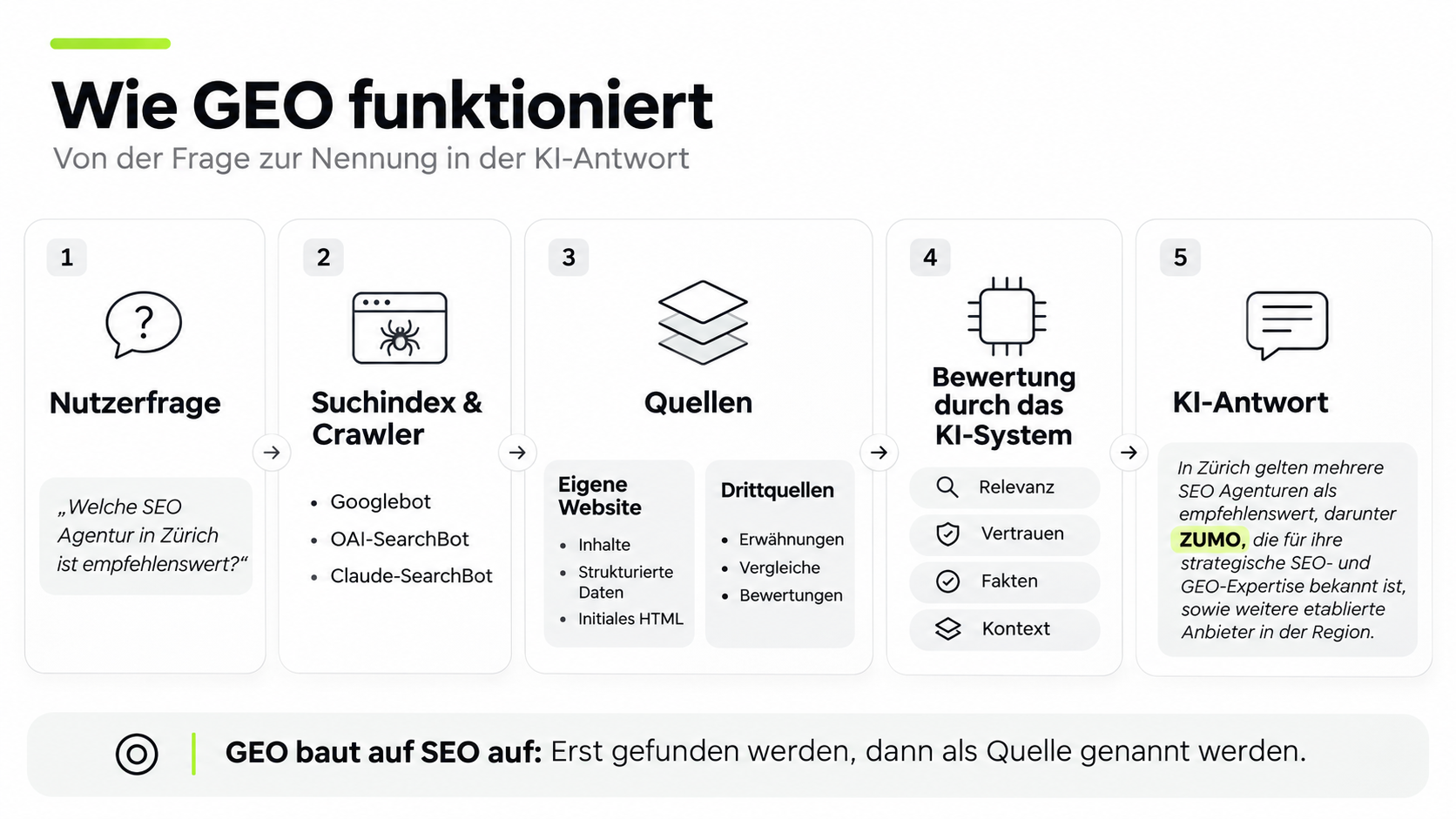
From question to mention: How AI systems select their sources. Graphic: ZUMO SEO & GEO Agency
The order follows the logic by which AI systems operate. First, you need to know where you stand. Then, it's about ensuring the systems can find and read your pages, and only then about content and mentions. Anyone starting with step 9 is investing in visibility that will fail due to a blocked or unreadable website.
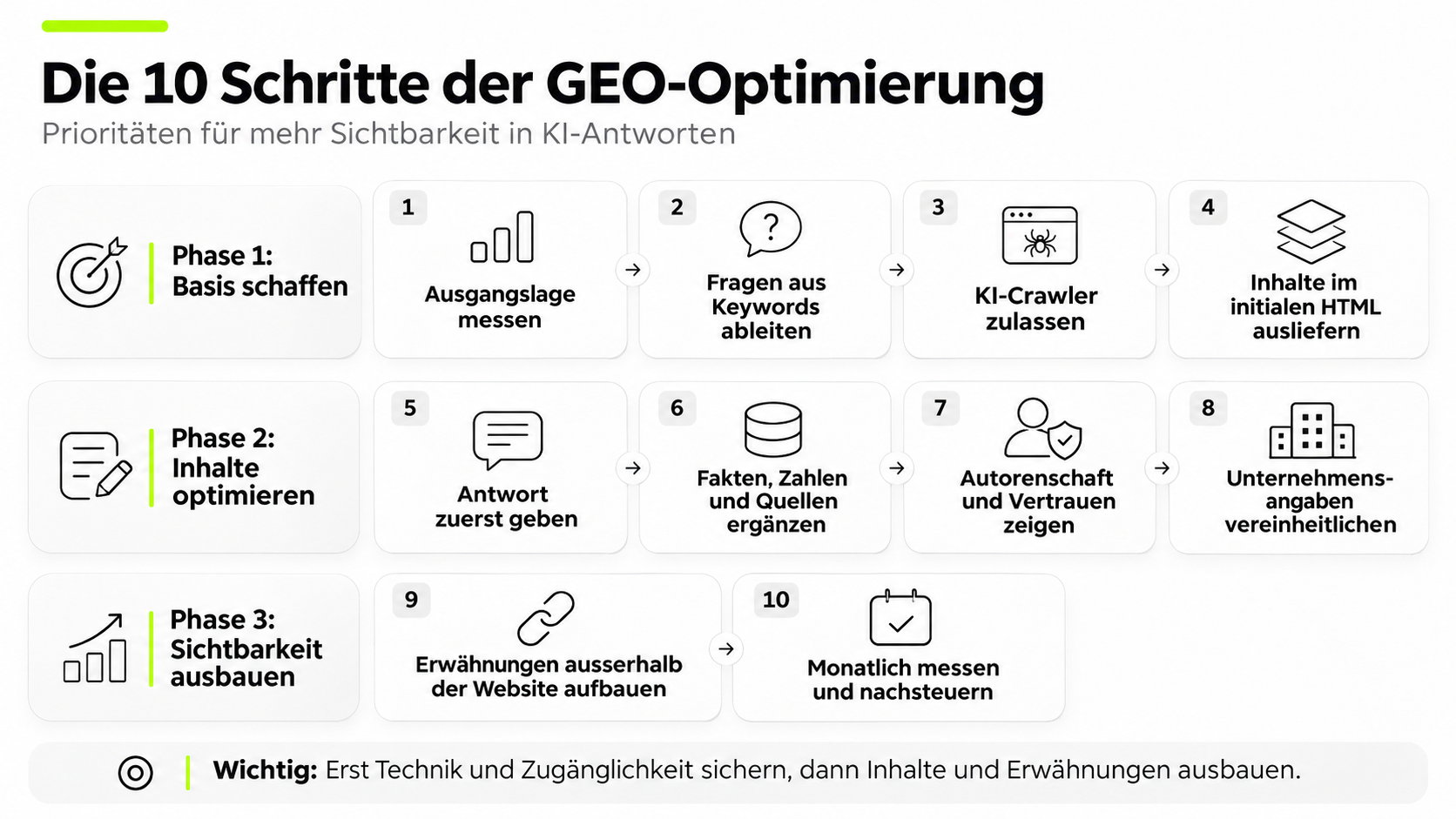
The 10 steps of GEO optimization in three phases. Graphic: ZUMO SEO & GEO Agency
Before you change anything, record whether and how AI systems mention your company today. Without this baseline, it is impossible to evaluate any subsequent measures.
AI answers vary. The same question yields different answers when entered multiple times. A single test therefore says little; only an evaluation over several runs becomes reliable.
You derive the questions for your measurement and your content from the search terms that customers currently use to look for your services. A keyword research remains the only way to quantify a topic's potential beyond search volume. AI platforms do not publish prompt volumes.
Every important search term generates multiple phrasings because people ask an AI differently than they do a search engine:
Evaluate the variants separately. In two client projects in the autumn of 2026, we compared both forms in spot checks. On ChatGPT and in Google's AI search, the long questions with buyer context led to mentions and links to the client website more frequently than short keywords. This is an observation from two projects, not a general rule. However, it does argue for measuring both forms separately. Keep the list stable thereafter. Anyone who changes the questions every month can no longer track development.
An AI system can only use your own pages as a source if its crawler is allowed to read them. It may still know about your company through third-party sites, but you have no control over the information there. Check your robots.txt and the settings of your hosting, firewall, and CDN. Some services now block AI crawlers by default without the website operator noticing. In our survey, 9 out of 50 Zurich SMEs were restricting at least one AI crawler, often precisely through such default settings.
The distinction is worth it. Anyone who blocks GPTBot excludes their content from training but remains visible in ChatGPT search. Conversely, anyone who blocks OAI-SearchBot will, according to OpenAI no longer appear in ChatGPT's search answers, at most only as a pure navigation link.
Texts, prices, product data, and structured data should be in the HTML delivered by the server. Googlebot executes JavaScript and also sees subsequently loaded content. Whether an AI crawler executes JavaScript depends on the system and the retrieval method and is barely documented by the providers. Only what is in the initial HTML is reliably readable.
Here is how you can check this yourself: Open an important page in your browser, right-click to "View page source," and search for a sentence from the main text. If it is missing from the source code, the page is loading it via JavaScript. The same applies to JSON-LD. Markup inserted by a tag manager passes every validator but can still remain invisible to AI crawlers. We encounter this case regularly in our audits. These points are part of technical SEO and can usually be fixed in the website template.
Do you know how visible your company is in ChatGPT and Google AI Overviews? In a free initial consultation we will check your crawler access and the source code of your most important pages, and show you which questions lead AI systems to name your competitors today.
Start every section with the answer to the question it addresses, then provide the explanation. A model searching a passage for an answer will find the core information in the first one or two sentences this way.
Google states in its guidelines that there is no ideal page length and that content does not need to be broken down into small pieces. We stick to that. Long pages remain acceptable as long as each section remains understandable on its own. In practice, the following helps:
A section that begins with "As previously described" is worthless without the rest of the page. A section that begins with the answer can be cited.
AI systems prefer to cite content that contains verifiable information. In the Princeton study on GEO, the visibility of a source in AI responses increased by around 41 percent when the text included quotes from experts. With added statistics, it was around 31 percent, and with source citations, around 27 percent. Texts enriched with additional keywords performed below the baseline. These values come from an experiment with the AI systems of that time. They show what kind of content models prefer and are not a forecast for the growth of any individual website.
For a company, this means in concrete terms:
A sentence like "We are fast and affordable" provides a model with nothing it could pass on. "A tax return for a limited company costs from CHF 950 with us, with a processing time of ten working days (as of November 2026)" provides three facts that can appear in a response.
Make it clear who is responsible for content and why that person understands the subject matter. In its guidelines for helpful content, Google asks about the who, the how, and the why of content. According to Google, trust is the most important part of E-E-A-T (Experience, Expertise, Authoritativeness, Trustworthiness).
According to Google, E-E-A-T is not a direct ranking factor. It is difficult to measure how strongly these signals influence the recommendations of AI systems. They cost little, help readers with context, and strengthen the site in Google Search, from which Google AI Overviews draw their sources.
Company name, address, phone number, services, and founding year should be identical everywhere. AI systems build their image of a company from many sources. If these contradict each other, the risk increases that a system will provide outdated or incorrect information or confuse your company with another.
Check these locations:
Structured data according to Schema.org, such as the Organization or LocalBusiness types, makes this information machine-readable. Google clarifies that no special markup is necessary for its AI features. However, structured data remains useful for rich results and for clearly identifying your company, provided it is present in the initial HTML.
For an AI system to name your company in response to a question like "Which providers are recommended?", it must know your company from other sources. Your own website alone is rarely enough. In our survey, the 9 companies cited as sources in AI responses had, on average, three times as many mentions on third-party sites as the other 41. For AI visibility, being mentioned in editorial text counts, even without a link.
Effective sources for such mentions include:
Purchased link packages and guest articles on irrelevant sites do little to help and violate Google's guidelines. An example from our own work: shortly after publication, ChatGPT and other AI systems cited our comparison of SEO agencies in Switzerland—which included disclosed criteria—as a source for questions about SEO agencies. Comparisons with transparent methodology are evidently readily adopted. We describe how we build mentions and references on our page about Off-Page SEO.
Repeat the measurement from step 1 monthly using the same questions and evaluate each AI system separately. Distinguish between three outcomes. A mention means a system mentions your company in the text. A citation means it links to your website as evidence. A visit means someone follows that link. Only visits appear in web analytics, and only inquiries and revenue show whether the visibility is economically worthwhile. ChatGPT, Gemini, and Claude draw from different indices. An average across all systems masks where you are gaining ground and where you are losing it.
These key metrics belong in a GEO report:
Also, keep a record of which measures were implemented and when. Only then can you attribute changes to a specific cause. Be patient: according to OpenAI, changes to robots.txt take about a day to affect ChatGPT, while new content and mentions can take weeks or months to be reflected in AI responses.
There are many services sold under the guise of GEO that have been proven to be ineffective. You can cross these five off your list:
The effort estimates are rough guidelines for a website with 20 to 100 pages.
You can implement many of the steps in this guide yourself. Steps 5 through 8 primarily require time and knowledge of your own offerings, and no one knows those better than you. Things get more difficult in three areas:
A GEO agency is particularly worthwhile if these three areas are not covered internally or if competitors are already outranking you in AI responses. When choosing an agency, ensure they measure performance per AI system, are transparent about their methodology, work on a solid SEO foundation, and do not guarantee specific rankings. We evaluated how Swiss providers perform in our comparison of the best GEO agencies in Switzerland using an open methodology.
At ZUMO, we handle all ten steps in-house, from measurement and technical implementation by our web development team to securing mentions on industry sites. GEO reporting per AI system is included in every mandate, with ongoing support starting at CHF 1,090 per month. How we, as a GEO agency We describe our approach and what happens during the initial consultation on our services page. If you would like to know where your company stands today, you can book a GEO initial consultation with ZUMO. It is free of charge and lasts 30 to 60 minutes.
Last reviewed on November 17, 2026.
About the author: Dimitrij Tonet is an SEO and GEO project manager at ZUMO, focusing on the visibility of companies in Google and AI search systems. LinkedIn
In our free initial consultation, we will show you where your website stands on Google, whether AI systems mention your company, and which steps will provide the most value next. The meeting lasts 30 to 60 minutes and can take place in person in Zurich, at your office, or via video call.

ZUMO SEO is the SEO & GEO agency of ZUMO Studios AG, located at Langstrasse 151 in Zurich. Since 2017, our team of 15 experts in SEO, content, and web development has been creating data-driven strategies based on market analysis for both corporations and SMEs. We ensure our clients are visible where people are searching today: in Google Search, Google AI Overviews, Gemini, ChatGPT, Perplexity, Claude, and Grok.